Featured project · 2026
MemSIF
From Structured Interactions to Dual-Track Fact Memory for LLM Agents
A structured interaction-to-fact memory framework that helps long-horizon agents preserve related evidence across time and turn information whose value emerges later into reusable facts.
Self-led research project · Project lead and first author
Problem and idea
Organizing long-term interactions beyond chronological order
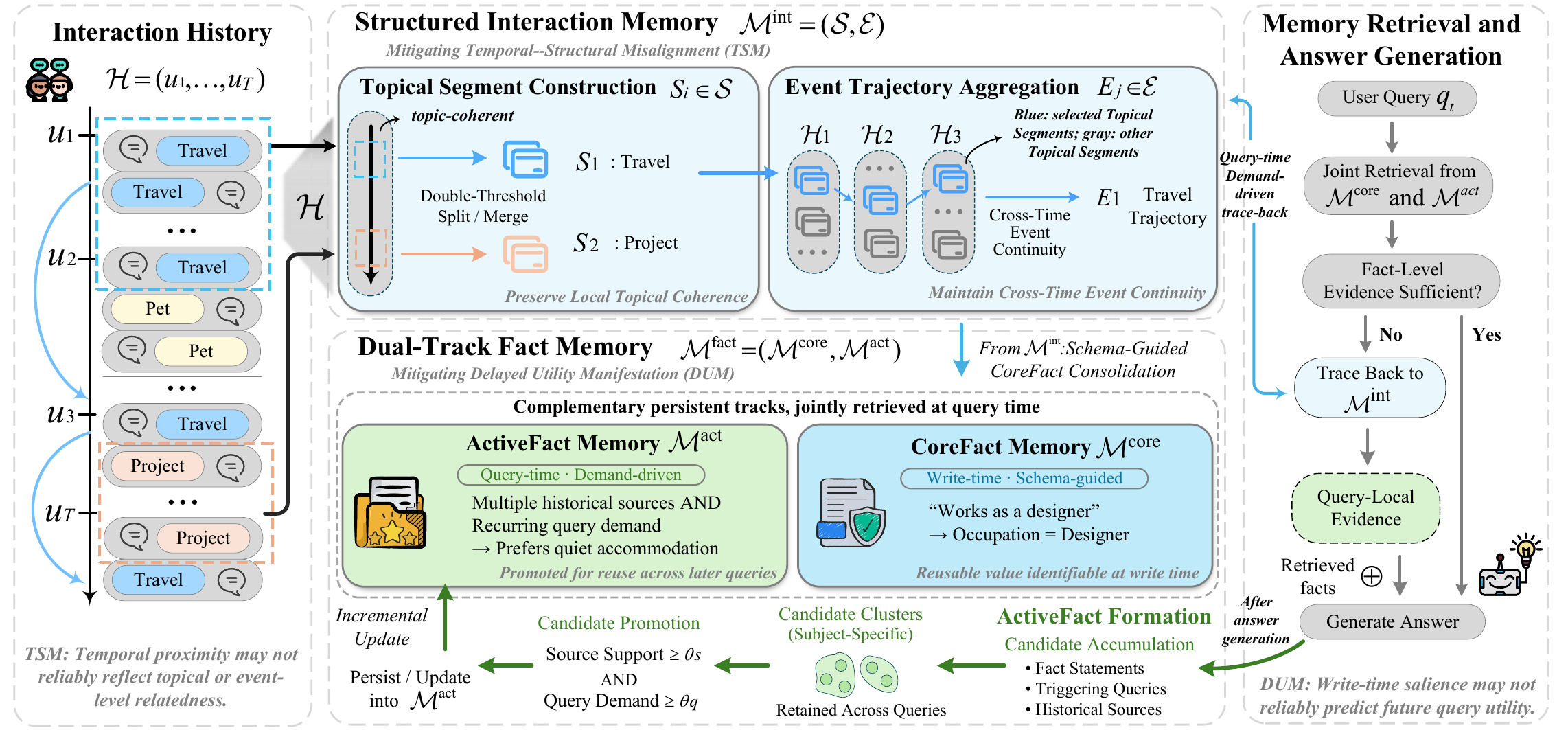
Long interaction histories are not naturally organized by time. Related evidence may be distributed across distant parts of a conversation, while information that appears unimportant when first observed may become valuable only after a later query. MemSIF characterizes these challenges as Temporal–Structural Misalignment (TSM) and Delayed Utility Manifestation (DUM).
To address them, MemSIF combines Structured Interaction Memory with Dual-Track Fact Memory. The first organizes interactions around their topical and event-level relationships; the second combines proactive fact consolidation with query-driven fact formation when information utility emerges later.
Evidence and continuity
An initial step toward reliable execution state
Across LoCoMo and LongMemEval-S with five backbone LLMs, MemSIF achieved the highest Total ACC in every evaluated setting, outperforming the strongest baseline by 2.29%–8.79% and 2.87%–6.15%, respectively.
MemSIF studies how an agent organizes what it has experienced and preserves it for future use. My next step is to investigate how agents can maintain the evolving execution state that directly supports their next action, creating a path toward state-supported verification, recovery, and reliable experience reuse over longer tasks.